ECHO CLIP
A functional clip that helps deaf users to sense loud noises through vibrations and dim lights
00

problem
People with hearing disabilities face constant barriers when interacting with environments that are not designed around accessible communication. Important sounds such as alarms, conversations, or public announcements are often difficult or impossible to perceive, directly affecting both safety and independence in everyday life. Many deaf individuals also depend on interpreters or hearing relatives during appointments, procedures, and public interactions, limiting direct communication and autonomy. Limited access to interpreters and inclusive educational systems further reinforces these challenges, forcing many students to rely on observation and imitation rather than clear instruction.
solution
EchoClip was designed as a wearable assistive device that improves environmental awareness and communication for deaf users. The product detects sudden increases in surrounding sound levels and alerts the user through soft vibration and subtle visual lighting. This allows users to become aware of important auditory events without relying on others. EchoClip also includes a secondary communication feature: by pressing a button, the device plays a pre-recorded message explaining that the user is deaf and may prefer to communicate through text. This creates a more independent and practical interaction in situations where using a phone is inconvenient or not possible.
The project initially started as a wristband concept focused on portability and constant body contact. However, during the development process, the design evolved into a clip-based wearable format. The clip offered greater versatility, allowing the device to be attached to clothing, backpacks, or placed on a desk for visual notifications. This change improved adaptability for different environments and user preferences while making the product feel less restrictive and more practical for daily use.
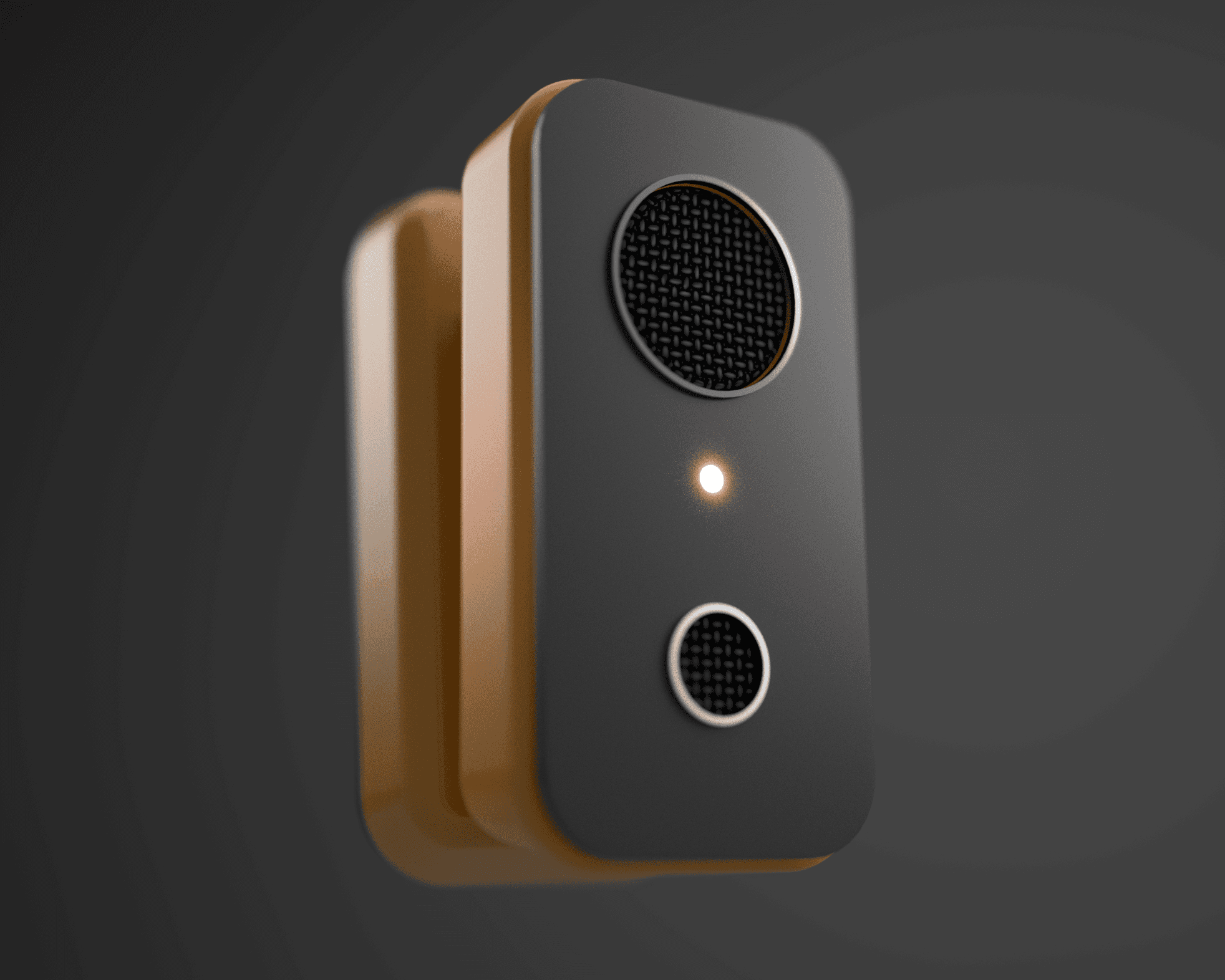
The product was digitally modeled in Fusion 360, where the form, internal component distribution, and attachment system were developed. Special attention was given to maintaining a compact and approachable appearance while still accommodating the electronics required for the sensing and notification systems. The final form balances functionality with simplicity, creating an object that feels discreet but intentional.
From a technical perspective, the prototype was powered by an Arduino Nano, which controlled the sound sensor, vibration motor, lighting system, and speaker functions. All electronic components were soldered and assembled manually, and the system was programmed to react to changes in ambient sound levels. Developing the prototype involved both hardware integration and programming, allowing the project to function as a fully interactive wearable device rather than only a conceptual design.
Throughout the process, EchoClip became more than a notification tool; it developed into a product focused on independence, accessibility, and inclusive interaction. The final result combines wearable technology with human-centered design to support clearer communication and environmental awareness in everyday situations.
year
2025
tools
Fusion360
category
product design
01

02

see also


